Course description

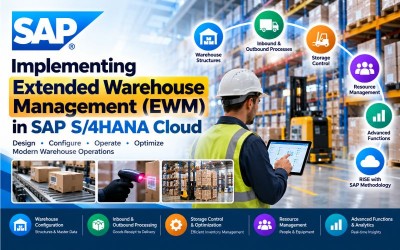
Implementing Extended Warehouse Management (EWM) in SAP S/4HANA Cloud is a comprehensive enterprise training program designed for SAP EWM consultants, SAP S/4HANA consultants, warehouse managers, logistics professionals, supply chain consultants, SAP implementation partners, business process analysts, and ERP professionals who want to implement and configure SAP Extended Warehouse Management (EWM) in SAP S/4HANA Cloud.

This course provides practical knowledge of SAP Extended Warehouse Management (EWM), including warehouse structures, master data, inbound and outbound processes, warehouse operations, storage control, resource management, warehouse customization, advanced warehouse functions, analytics, physical inventory, and RISE with SAP methodology. Learners will gain hands-on experience implementing SAP EWM using SAP S/4HANA Cloud while following SAP best practices.

Following SAP's official Learning Journey, the course progresses from EWM fundamentals through warehouse implementation, warehouse customization, resource management, advanced warehouse processes, and RISE with SAP methodology.

Modern warehouses require intelligent, automated, and highly efficient warehouse management systems to optimize inventory, improve operational efficiency, and support end-to-end supply chain processes. SAP Extended Warehouse Management (EWM) in SAP S/4HANA Cloud enables organizations to manage complex warehouse operations with real-time inventory visibility, advanced storage control, warehouse automation, and integrated logistics execution.

This course introduces the complete implementation lifecycle of SAP EWM within SAP S/4HANA Cloud. Participants will learn how to configure warehouse structures, master data, inbound logistics, outbound processing, warehouse operations, storage control, resource management, warehouse customization, physical inventory, warehouse analytics, and advanced warehouse functions.

Throughout the course, learners will gain practical implementation experience while following SAP best practices and real-world enterprise warehouse management scenarios.

By the end of this course, participants will possess the knowledge required to implement, configure, optimize, and support SAP Extended Warehouse Management in enterprise SAP S/4HANA Cloud environments.

Who Should Attend

  • SAP EWM Consultants
  • SAP S/4HANA Consultants
  • Warehouse Managers
  • Supply Chain Consultants
  • Logistics Consultants
  • SAP Functional Consultants
  • SAP Technical Consultants
  • SAP Implementation Partners
  • Inventory Managers
  • Operations Managers
  • Business Process Consultants
  • ERP Consultants
  • Distribution Center Managers
  • Warehouse Supervisors
  • Digital Supply Chain Professionals

Skills You Will Gain

  • SAP Extended Warehouse Management (EWM)
  • Warehouse Structures
  • Warehouse Master Data
  • Inbound Processing
  • Outbound Processing
  • Storage Control
  • Warehouse Process Types
  • Warehouse Orders
  • Physical Inventory
  • Warehouse Analytics
  • Resource Management
  • Warehouse Automation
  • Warehouse Customizing
  • SAP S/4HANA Cloud
  • RISE with SAP Methodology
  • Enterprise Warehouse Management

Career Opportunities

  • SAP EWM Consultant
  • SAP Warehouse Management Consultant
  • SAP S/4HANA Functional Consultant
  • Supply Chain Consultant
  • Warehouse Solution Architect
  • Logistics Consultant
  • Inventory Management Consultant
  • Distribution Center Consultant
  • SAP Implementation Consultant
  • Warehouse Operations Manager
  • SAP SCM Consultant
  • ERP Logistics Consultant
  • SAP Solution Architect
  • SAP Supply Chain Specialist
  • Warehouse Automation Consultant

These roles are highly valued across manufacturing, retail, e-commerce, logistics, pharmaceuticals, automotive, FMCG, wholesale distribution, transportation, third-party logistics (3PL), and organizations implementing SAP S/4HANA Cloud.

Certification Preparation

This course is designed to support learners preparing for SAP Extended Warehouse Management (EWM) and SAP S/4HANA Cloud certifications by covering the concepts included in SAP's official Learning Journey.

Participants will gain practical knowledge in:

  • SAP Extended Warehouse Management
  • Warehouse Structures
  • Master Data
  • Inbound & Outbound Processes
  • Warehouse Process Types
  • Storage Control
  • Resource Management
  • Warehouse Analytics
  • Physical Inventory
  • RISE with SAP Methodology

The course combines conceptual learning with practical warehouse implementation scenarios to prepare learners for enterprise SAP warehouse management projects and certification success.

What will i learn?

  • Understand SAP Extended Warehouse Management (EWM).
  • Configure warehouse structures and master data.
  • Implement inbound warehouse processes.
  • Configure outbound warehouse processes.
  • Manage warehouse operations.
  • Configure warehouse process types.
  • Implement storage control.
  • Configure warehouse resource management.
  • Implement advanced warehouse functions.
  • Support enterprise warehouse operations using SAP S/4HANA Cloud.

Requirements

  • Basic SAP knowledge
  • Understanding of warehouse and logistics processes
  • Basic supply chain management concepts
  • Familiarity with ERP systems
  • Interest in warehouse operations
  • Computer or Laptop
  • Stable Internet Connection
  • Modern Web Browser
  • SAP S/4HANA Cloud Trial or Practice Environment (Recommended)

Frequently asked question

Yes. The course starts with SAP EWM fundamentals before progressing to enterprise warehouse implementation, customization, resource management, and advanced warehouse operations.

No. Basic SAP knowledge is beneficial, but the course introduces SAP Extended Warehouse Management from the fundamentals.

Yes. You will learn how to configure warehouse structures, warehouse master data, and core warehouse processes.

Yes. The course covers warehouse process types, storage control, warehouse orders, physical inventory, and other customization activities.

Yes. You will learn how to define, configure, and execute resource management within SAP EWM.

Yes. The course introduces analytics, packed materials, warehouse expansion, special products, value-added services, serial numbers, kitting, and batch-managed products.

Yes. The course concludes with the RISE with SAP methodology, SAP Activate support tools, and customer success visualization.

You will gain practical implementation experience in configuring SAP EWM, managing warehouse operations, customizing warehouse processes, implementing storage control, managing resources, performing physical inventory, and supporting enterprise warehouse management using SAP S/4HANA Cloud.

  • Lesson 01 00:00:00
    Module 1 Overview

    SAP Extended Warehouse Management (SAP EWM) provides comprehensive warehouse management capabilities that enable organizations to efficiently manage inventory, warehouse operations, inbound logistics, outbound logistics, and storage processes. It supports complex warehouse environments through advanced process automation, resource optimization, and real-time inventory visibility.

    This module introduces the business processes of SAP EWM, including warehouse structures, master data, inbound and outbound warehouse processes, warehouse operations, and additional warehouse functions. Participants will gain the foundational knowledge required to implement and operate SAP EWM in SAP S/4HANA Cloud.

    By the end of this module, learners will understand the core warehouse processes and business functions available in SAP EWM.

    According to the SAP Learning Journey, this module focuses on warehouse structures, master data, core warehouse processes, storage control, replenishment methods, and practical warehouse operations.

    What You Will Learn

    • Understand SAP EWM business processes.
    • Configure warehouse structures.
    • Maintain warehouse master data.
    • Execute inbound warehouse processes.
    • Execute outbound warehouse processes.
    • Operate warehouse activities.
    • Apply additional warehouse functions.
    • Support enterprise warehouse operations.

    Units in This Module

    • Unit 1.1: Maintaining Warehouse Structures and Master Data
    • Unit 1.2: Performing Basic Processes in SAP EWM
    • Unit 1.3: Operating the Warehouse
    • Unit 1.4: Employing Additional Functions in SAP EWM
  • Lesson 02 00:00:00
    1.1 Maintaining Warehouse Structures and Master Data

    Warehouse structures and master data form the foundation of SAP EWM. Proper warehouse organization enables efficient inventory management, storage optimization, and accurate warehouse execution.

    This unit introduces warehouse organizational structures, storage types, storage bins, activity areas, warehouse numbers, products, packaging specifications, and warehouse master data.

    Key Topics

    • Warehouse Structure
    • Warehouse Number
    • Storage Type
    • Storage Bin
    • Activity Areas
    • Warehouse Master Data
    • Product Master
    • Packaging Specifications
  • Lesson 03 00:00:00
    1.2 Performing Basic Processes in SAP EWM

    SAP EWM supports the complete warehouse lifecycle by managing inbound logistics, goods receipt, stock placement, picking, packing, and outbound delivery processes. These business processes improve warehouse efficiency and inventory accuracy.

    Participants will learn the execution flow of inbound and outbound warehouse processes along with warehouse task management.

    Key Topics

    • Goods Receipt
    • Inbound Processing
    • Outbound Processing
    • Picking
    • Packing
    • Warehouse Tasks
    • Stock Management
    • Delivery Processing
  • Lesson 04 00:00:00
    1.3 Operating the Warehouse

    Warehouse Operations involve the daily execution of warehouse activities including inventory movements, warehouse task execution, replenishment, stock transfers, warehouse monitoring, and operational control.

    This unit explains warehouse execution processes, operational workflows, and inventory movement management within SAP EWM.

    Key Topics

    • Warehouse Operations
    • Warehouse Tasks
    • Inventory Management
    • Stock Transfer
    • Replenishment
    • Warehouse Monitoring
    • Operational Execution
    • Warehouse Activities
  • Lesson 05 00:00:00
    1.4 Employing Additional Functions in SAP EWM

    SAP EWM includes advanced warehouse capabilities that enhance operational efficiency through storage control, batch management, warehouse optimization, and specialized warehouse processing functions.

    Participants will explore additional EWM functionality used in enterprise warehouse environments.

    Key Topics

    • Storage Control
    • Batch Management
    • Warehouse Optimization
    • Warehouse Functions
    • Advanced Processing
    • Inventory Control
    • Warehouse Automation
    • SAP EWM Features

  • Lesson 01 00:00:00
    Module 2 Overview

    Warehouse customization enables organizations to configure SAP EWM according to business requirements while supporting efficient warehouse execution, inventory control, storage management, and logistics processes.

    This module introduces warehouse integration, warehouse process types, warehouse master data configuration, putaway strategies, stock removal strategies, warehouse orders, physical inventory, replenishment, and warehouse customization.

    By the end of this module, learners will be able to configure SAP EWM for enterprise warehouse operations.

    According to the SAP Learning Journey, this module covers integration between SAP ERP and SAP EWM, warehouse master data, warehouse process types, goods receipt, shipping, storage control, warehouse orders, replenishment, physical inventory, and the Post Processing Framework (PPF).

    What You Will Learn

    • Configure SAP EWM integration.
    • Configure warehouse master data.
    • Apply warehouse process types.
    • Configure putaway strategies.
    • Configure stock removal strategies.
    • Create warehouse orders.
    • Configure replenishment.
    • Execute physical inventory.
    • Configure storage control.
    • Implement warehouse customization.

    Units in This Module

    • Unit 2.1: Introducing SAP Extended Warehouse Management (SAP EWM) System Environment
    • Unit 2.2: Setting Up Integration
    • Unit 2.3: Setting Up and Creating Structural Elements and Master Data
    • Unit 2.4: Applying Warehouse Process Types
    • Unit 2.5: Receiving Goods in the Warehouse
    • Unit 2.6: Shipping Goods from the Warehouse
    • Unit 2.7: Outlining and Configuring Storage Control
    • Unit 2.8: Creating Warehouse Orders
    • Unit 2.9: Performing Posting Changes, Stock Transfers, and Replenishment
    • Unit 2.10: Setting Up and Executing Physical Inventory
    • Unit 2.11: Outlining the Post Processing Framework (PPF)
  • Lesson 02 00:00:00
    2.1 Introducing SAP Extended Warehouse Management (SAP EWM) System Environment

    This unit introduces the SAP EWM system landscape, architecture, deployment options, and system components. Learners will understand how SAP EWM integrates with SAP ERP and SAP S/4HANA Cloud to support warehouse operations.

    Key Topics

    • SAP EWM Architecture
    • System Landscape
    • SAP ERP Integration
    • SAP S/4HANA Cloud
    • Warehouse Environment
    • Deployment Options
    • System Components
    • Enterprise Warehouse Management
  • Lesson 03 00:00:00
    2.2 Setting Up Integration

    Integration between SAP ERP and SAP EWM enables synchronized warehouse operations, inventory updates, logistics execution, and seamless communication between enterprise systems.

    Participants will learn the configuration required to establish successful system integration.

    Key Topics

    • SAP ERP Integration
    • System Connectivity
    • Data Synchronization
    • Warehouse Integration
    • Communication Setup
    • Enterprise Integration
    • SAP Interfaces
    • Integration Configuration
  • Lesson 04 00:00:00
    2.3 Setting Up and Creating Structural Elements and Master Data

    Proper configuration of warehouse structural elements and master data ensures efficient warehouse execution, inventory accuracy, and optimized storage management.

    Key Topics

    • Warehouse Structure
    • Master Data
    • Storage Types
    • Storage Sections
    • Warehouse Products
    • Packaging Specifications
    • Warehouse Configuration
    • Structural Elements
  • Lesson 05 00:00:00
    2.4 Applying Warehouse Process Types

    Warehouse Process Types define how warehouse activities such as putaway, picking, internal movements, replenishment, and stock transfers are executed within SAP EWM. Proper configuration ensures efficient warehouse execution while supporting different operational scenarios and business requirements.

    This unit introduces warehouse process types, execution rules, process determination, warehouse tasks, and operational configuration.

    Key Topics

    • Warehouse Process Types
    • Warehouse Tasks
    • Process Determination
    • Putaway Processes
    • Picking Processes
    • Internal Warehouse Movements
    • Warehouse Execution
    • Process Configuration
  • Lesson 06 00:00:00
    2.5 Receiving Goods in the Warehouse

    Inbound warehouse processing manages goods receipt, unloading, quality inspection, putaway, and inventory updates. SAP EWM provides comprehensive inbound logistics capabilities to improve warehouse efficiency and inventory accuracy.

    Participants will learn the complete inbound warehouse process from goods receipt through storage.

    Key Topics

    • Goods Receipt
    • Inbound Delivery
    • Unloading
    • Quality Inspection
    • Putaway
    • Warehouse Tasks
    • Inventory Update
    • Inbound Processing
  • Lesson 07 00:00:00
    2.6 Shipping Goods from the Warehouse

    Outbound warehouse processing supports order fulfillment by managing picking, packing, staging, loading, and goods issue. SAP EWM ensures efficient outbound logistics through optimized warehouse execution.

    Key Topics

    • Outbound Delivery
    • Picking
    • Packing
    • Staging
    • Loading
    • Goods Issue
    • Warehouse Orders
    • Shipping Processes
  • Lesson 08 00:00:00
    2.7 Outlining and Configuring Storage Control

    Storage Control enables organizations to define warehouse movement strategies that optimize goods flow and warehouse efficiency. SAP EWM supports process-oriented and layout-oriented storage control for complex warehouse operations.

    Key Topics

    • Storage Control
    • Layout-Oriented Storage Control
    • Process-Oriented Storage Control
    • Warehouse Routing
    • Warehouse Movements
    • Storage Strategies
    • Warehouse Configuration
    • Process Optimization
  • Lesson 09 00:00:00
    2.8 Creating Warehouse Orders

    Warehouse Orders organize warehouse tasks into executable work packages for warehouse operators. Efficient warehouse order creation improves resource utilization, warehouse productivity, and operational efficiency.

    Key Topics

    • Warehouse Orders
    • Warehouse Tasks
    • Work Packages
    • Order Creation
    • Warehouse Execution
    • Task Assignment
    • Warehouse Productivity
    • Resource Optimization
  • Lesson 10 00:00:00
    2.9 Performing Posting Changes, Stock Transfers, and Replenishment

    SAP EWM supports inventory adjustments, posting changes, stock transfers, and replenishment to maintain inventory accuracy and ensure stock availability throughout warehouse operations.

    Key Topics

    • Posting Changes
    • Stock Transfers
    • Replenishment
    • Inventory Management
    • Stock Movement
    • Warehouse Inventory
    • Inventory Accuracy
    • Warehouse Operations
  • Lesson 11 00:00:00
    2.10 Setting Up and Executing Physical Inventory

    Physical Inventory enables organizations to verify inventory accuracy through planned counting procedures, reconciliation, and inventory adjustments. SAP EWM supports multiple inventory methods for warehouse operations.

    Key Topics

    • Physical Inventory
    • Inventory Counting
    • Cycle Counting
    • Inventory Verification
    • Stock Reconciliation
    • Inventory Adjustment
    • Warehouse Audit
    • Inventory Accuracy
  • Lesson 12 00:00:00
    2.11 Outlining the Post Processing Framework (PPF)

    The Post Processing Framework (PPF) automates follow-up activities and business processes within SAP EWM. It supports event-driven processing, document output, workflow execution, and warehouse automation.

    Key Topics

    • Post Processing Framework
    • PPF
    • Workflow Automation
    • Event Management
    • Output Determination
    • Warehouse Automation
    • Process Automation
    • SAP EWM Framework

  • Lesson 01 00:00:00
    Module 3 Overview

    Resource Management enables organizations to efficiently allocate warehouse personnel, equipment, and operational resources to warehouse tasks. SAP EWM provides tools for planning, assigning, monitoring, and optimizing warehouse resources to improve productivity and operational efficiency.

    This module introduces resource management concepts, resource definition, configuration, execution, monitoring, and optimization within SAP Extended Warehouse Management.

    By the end of this module, learners will be able to configure and manage warehouse resources using SAP EWM.

    According to the SAP Learning Journey, this module covers managing resources, defining resource management, configuring resource management, and executing resource management.

    What You Will Learn

    • Understand Resource Management.
    • Define warehouse resources.
    • Configure resource management.
    • Assign warehouse resources.
    • Execute warehouse resource planning.
    • Monitor resource utilization.
    • Improve warehouse productivity.

    Units in This Module

    • Unit 3.1: Managing Resources
    • Unit 3.2: Defining Resource Management
    • Unit 3.3: Configuring Resource Management
    • Unit 3.4: Executing Resource Management
  • Lesson 02 00:00:00
    3.1 Managing Resources

    Warehouse Resources include personnel, forklifts, material handling equipment, and operational assets used during warehouse execution. Efficient resource management improves warehouse productivity, task execution, and operational performance.

    Key Topics

    • Warehouse Resources
    • Resource Planning
    • Resource Assignment
    • Warehouse Personnel
    • Equipment Management
    • Operational Resources
    • Warehouse Productivity
    • SAP EWM Resources
  • Lesson 03 00:00:00
    3.2 Defining Resource Management

    Resource Management Configuration enables organizations to define resource groups, qualifications, work centers, and assignment rules that optimize warehouse operations and improve task execution.

    Key Topics

    • Resource Groups
    • Qualifications
    • Work Centers
    • Assignment Rules
    • Resource Configuration
    • Warehouse Organization
    • Resource Definition
    • Operational Planning
  • Lesson 04 00:00:00
    3.3 Configuring Resource Management

    This unit explains how to configure warehouse resource management, define operational parameters, establish assignment strategies, and optimize warehouse execution using SAP EWM.

    Key Topics

    • Resource Configuration
    • Assignment Strategies
    • Warehouse Configuration
    • Operational Parameters
    • Resource Optimization
    • Warehouse Execution
    • Configuration Settings
    • Productivity Management
  • Lesson 05 00:00:00
    3.4 Executing Resource Management

    Executing Resource Management involves assigning warehouse tasks, monitoring resource utilization, balancing workloads, and improving warehouse performance through efficient operational planning.

    Key Topics

    • Resource Execution
    • Workload Balancing
    • Task Assignment
    • Resource Monitoring
    • Warehouse Operations
    • Productivity Analytics
    • Operational Performance
    • Continuous Improvement

  • Lesson 01 00:00:00
    Module 4 Overview

    Advanced Warehouse Functions extend the capabilities of SAP Extended Warehouse Management (EWM) by supporting specialized warehouse operations, value-added services, packing, serial number management, batch-controlled products, kitting, cross-docking, and warehouse optimization. These capabilities enable organizations to efficiently manage complex warehouse environments while improving operational productivity and inventory accuracy.

    This module introduces advanced warehouse processes, warehouse optimization techniques, specialized product handling, warehouse automation, analytics, and operational best practices.

    By the end of this module, learners will be able to configure and implement advanced warehouse functions in SAP EWM.

    According to the SAP Learning Journey, this module covers packed products, warehouse optimization, special products, value-added services, kitting, batch-managed products, serial numbers, and warehouse analytics.

    What You Will Learn

    • Configure advanced warehouse functions.
    • Manage packed products.
    • Configure warehouse optimization.
    • Handle special warehouse products.
    • Configure value-added services.
    • Manage serial numbers.
    • Configure batch-managed products.
    • Execute kitting processes.
    • Analyze warehouse performance.
    • Optimize warehouse operations.

    Units in This Module

    • Unit 4.1: Managing Packed Products
    • Unit 4.2: Employing Warehouse Optimization
    • Unit 4.3: Employing Special Products
    • Unit 4.4: Applying Value-Added Services (VAS)
    • Unit 4.5: Employing Kitting
    • Unit 4.6: Managing Batch-Controlled Products
    • Unit 4.7: Managing Serial Numbers
    • Unit 4.8: Employing Warehouse Analytics
  • Lesson 02 00:00:00
    4.1 Managing Packed Products

    Packed Products enable warehouse operators to manage handling units, packaging materials, and packed inventory efficiently. SAP EWM supports flexible packing processes that improve warehouse productivity and logistics execution.

    Key Topics

    • Packed Products
    • Handling Units
    • Packaging Materials
    • Packing Operations
    • Warehouse Packaging
    • Product Handling
    • Logistics Execution
    • SAP EWM Packing
  • Lesson 03 00:00:00
    4.2 Employing Warehouse Optimization

    Warehouse Optimization improves warehouse efficiency by optimizing storage utilization, travel paths, task execution, warehouse layout, and operational workflows. SAP EWM provides various optimization techniques that enhance productivity and reduce operational costs.

    Key Topics

    • Warehouse Optimization
    • Task Optimization
    • Storage Optimization
    • Warehouse Layout
    • Process Optimization
    • Operational Efficiency
    • Warehouse Productivity
    • SAP EWM Optimization
  • Lesson 04 00:00:00
    4.3 Employing Special Products

    SAP EWM supports specialized product handling for hazardous materials, temperature-controlled products, high-value inventory, and other products requiring special warehouse processing.

    Key Topics

    • Special Products
    • Hazardous Materials
    • Temperature-Controlled Products
    • High-Value Inventory
    • Product Classification
    • Specialized Storage
    • Warehouse Compliance
    • Product Handling
  • Lesson 05 00:00:00
    4.4 Applying Value-Added Services (VAS)

    Value-Added Services (VAS) enable organizations to perform additional warehouse activities such as labeling, inspection, assembly, repacking, customization, and product enhancement before shipment.

    Key Topics

    • Value-Added Services
    • Product Labeling
    • Product Inspection
    • Repacking
    • Assembly
    • Warehouse Processing
    • Customer-Specific Services
    • Warehouse Customization
  • Lesson 06 00:00:00
    4.5 Employing Kitting

    Kitting combines multiple products into a single kit to simplify warehouse operations and improve order fulfillment. SAP EWM supports kit creation, inventory tracking, and warehouse execution for kitting processes.

    Key Topics

    • Kitting
    • Product Assembly
    • Kit Management
    • Warehouse Kits
    • Inventory Tracking
    • Warehouse Operations
    • Kit Processing
    • Order Fulfillment
  • Lesson 07 00:00:00
    4.6 Managing Batch-Controlled Products

    Batch Management enables organizations to trace inventory based on production batches, ensuring product quality, regulatory compliance, and complete inventory traceability.

    Key Topics

    • Batch Management
    • Batch-Controlled Products
    • Product Traceability
    • Inventory Tracking
    • Batch Processing
    • Quality Management
    • Warehouse Compliance
    • SAP EWM
  • Lesson 08 00:00:00
    4.7 Managing Serial Numbers

    Serial Number Management enables organizations to uniquely identify products throughout warehouse operations, improving inventory accuracy, warranty tracking, and product lifecycle management.

    Key Topics

    • Serial Numbers
    • Product Identification
    • Inventory Traceability
    • Warranty Tracking
    • Warehouse Inventory
    • Product Lifecycle
    • Inventory Accuracy
    • SAP EWM
  • Lesson 09 00:00:00
    4.8 Employing Warehouse Analytics

    Warehouse Analytics provides operational dashboards, warehouse KPIs, inventory reports, and performance metrics that enable organizations to monitor warehouse efficiency and continuously improve operations.

    Key Topics

    • Warehouse Analytics
    • Operational Dashboards
    • Warehouse KPIs
    • Inventory Reports
    • Performance Metrics
    • Operational Reporting
    • Business Intelligence
    • Continuous Improvement

  • Lesson 01 00:00:00
    Module 5 Overview

    RISE with SAP provides organizations with a business transformation approach that combines SAP S/4HANA Cloud, SAP Business Technology Platform (BTP), SAP Business Network, SAP Signavio, and SAP LeanIX to accelerate digital transformation and cloud adoption.

    This module introduces the RISE with SAP methodology, SAP Activate implementation approach, customer success visualization, transformation planning, implementation tools, and best practices for successful SAP EWM deployments.

    By the end of this module, learners will understand how SAP EWM implementations align with the RISE with SAP transformation strategy.

    According to the SAP Learning Journey, this module covers the RISE with SAP Methodology, SAP Activate, Customer Success Visualization, and related implementation guidance.

    What You Will Learn

    • Understand the RISE with SAP methodology.
    • Explain SAP Activate methodology.
    • Understand customer success visualization.
    • Plan SAP EWM implementations.
    • Apply SAP implementation best practices.
    • Support digital transformation initiatives.

    Units in This Module

    • Unit 5.1: Exploring the RISE with SAP Methodology
    • Unit 5.2: Using SAP Activate
    • Unit 5.3: Visualizing Customer Success
  • Lesson 02 00:00:00
    5.1 Exploring the RISE with SAP Methodology

    This unit introduces the RISE with SAP transformation methodology and explains how it supports cloud migration, business process transformation, and enterprise modernization through SAP S/4HANA Cloud and integrated SAP solutions.

    Key Topics

    • RISE with SAP
    • Digital Transformation
    • Cloud Adoption
    • Business Transformation
    • SAP S/4HANA Cloud
    • Enterprise Modernization
    • Transformation Strategy
    • SAP Solutions
  • Lesson 03 00:00:00
    5.2 Using SAP Activate

    SAP Activate provides a structured implementation methodology that combines SAP Best Practices, guided configuration, agile project management, and implementation accelerators to streamline SAP EWM deployments.

    Key Topics

    • SAP Activate
    • Agile Implementation
    • SAP Best Practices
    • Guided Configuration
    • Project Management
    • Fit-to-Standard
    • Implementation Roadmap
    • SAP Methodology
  • Lesson 04 00:00:00
    5.3 Visualizing Customer Success

    Customer Success Visualization helps organizations measure implementation progress, business outcomes, solution adoption, and operational success throughout the SAP EWM implementation lifecycle.

    Key Topics

    • Customer Success
    • Business Outcomes
    • Implementation Progress
    • Adoption Metrics
    • Success KPIs
    • Operational Excellence
    • Performance Measurement
    • Continuous Improvement

  • Lesson 01 00:00:00
    Practical Exercises

    Throughout this course, learners will complete practical exercises based on real-world warehouse implementation scenarios using SAP Extended Warehouse Management (EWM) in SAP S/4HANA Cloud.

    These exercises reinforce both conceptual understanding and hands-on implementation skills.

    Participants will perform the following activities:

    • Configure Warehouse Structures
    • Create Warehouse Master Data
    • Configure Storage Types and Storage Bins
    • Process Goods Receipt
    • Execute Putaway Strategies
    • Configure Warehouse Process Types
    • Perform Picking and Packing
    • Execute Outbound Delivery Processing
    • Configure Storage Control
    • Create Warehouse Orders
    • Configure Replenishment
    • Execute Stock Transfers
    • Perform Physical Inventory
    • Configure Resource Management
    • Manage Warehouse Resources
    • Configure Value-Added Services (VAS)
    • Execute Kitting Processes
    • Manage Batch-Controlled Products
    • Configure Serial Number Management
    • Analyze Warehouse Performance
    • Configure Warehouse Analytics
    • Implement SAP Activate Methodology
  • Lesson 02 00:00:00
    Enterprise Implementation Project

    Implementing SAP Extended Warehouse Management (EWM) in SAP S/4HANA Cloud

    This capstone project provides learners with the opportunity to implement a complete SAP EWM solution for a multinational organization operating multiple warehouses.

    Participants will configure warehouse structures, integrate warehouse processes with SAP S/4HANA Cloud, optimize inventory movement, manage warehouse resources, configure advanced warehouse functions, and monitor warehouse performance.

    The implementation project follows the business processes covered throughout the SAP Learning Journey.

    Business Scenario

    A multinational manufacturing and distribution company operates regional distribution centers across multiple countries. Due to increasing customer demand, inventory growth, and complex logistics operations, the organization has decided to implement SAP Extended Warehouse Management (EWM) on SAP S/4HANA Cloud.

    The primary objectives are to:

    • Improve warehouse efficiency.
    • Optimize inventory visibility.
    • Automate warehouse operations.
    • Increase order fulfillment accuracy.
    • Reduce warehouse operating costs.
    • Improve inbound and outbound logistics.
    • Support real-time warehouse analytics.

    As the SAP EWM Functional Consultant, you are responsible for implementing the complete warehouse management solution while following SAP Best Practices and the SAP Activate implementation methodology.

    Project Deliverables

    Phase 1 – Warehouse Foundation

    Configure:

    • Warehouse Number
    • Storage Types
    • Storage Sections
    • Storage Bins
    • Activity Areas
    • Work Centers
    • Warehouse Master Data
    • Product Master

    Phase 2 – Warehouse Operations

    Implement:

    • Goods Receipt
    • Putaway
    • Warehouse Tasks
    • Warehouse Orders
    • Picking
    • Packing
    • Goods Issue
    • Outbound Delivery

    Phase 3 – Warehouse Configuration

    Configure:

    • Warehouse Process Types
    • Putaway Strategies
    • Stock Removal Strategies
    • Replenishment
    • Storage Control
    • Warehouse Monitoring

    Phase 4 – Inventory Management

    Implement:

    • Physical Inventory
    • Cycle Counting
    • Stock Transfers
    • Posting Changes
    • Batch Management
    • Serial Number Management

    Phase 5 – Advanced Warehouse Functions

    Configure:

    • Value-Added Services (VAS)
    • Kitting
    • Packed Products
    • Special Products
    • Warehouse Optimization
    • Warehouse Analytics

    Phase 6 – Resource Management

    Implement:

    • Warehouse Resources
    • Resource Groups
    • Task Assignment
    • Resource Monitoring
    • Workload Balancing
    • Productivity Analysis

    Phase 7 – SAP Activate & Deployment

    Complete:

    • Fit-to-Standard Workshops
    • System Configuration
    • Testing
    • User Acceptance Testing (UAT)
    • End-User Training
    • Go-Live Preparation
    • Hypercare Support

    Expected Project Outcome

    After successfully completing this implementation project, learners will be able to:

    • Design enterprise warehouse structures.
    • Configure SAP EWM in SAP S/4HANA Cloud.
    • Execute inbound and outbound warehouse processes.
    • Configure warehouse process types.
    • Manage warehouse inventory.
    • Implement resource management.
    • Configure advanced warehouse functions.
    • Execute physical inventory.
    • Apply SAP Activate methodology.
    • Support enterprise warehouse operations.

Jittesh Purrohit

Lectures

37

Skill level

Intermediate

Expiry period

Lifetime

Related courses