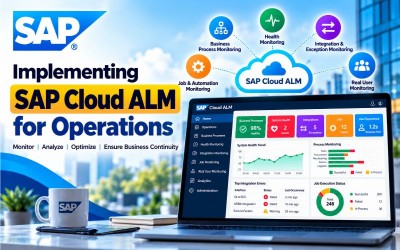
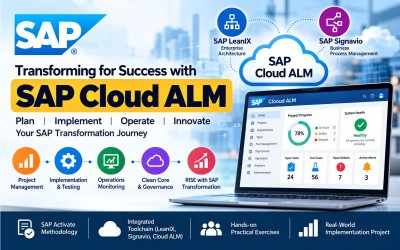
Implementing SAP Cloud ALM for Operations is a comprehensive enterprise-level training program designed for SAP consultants, SAP Basis administrators, SAP Cloud ALM consultants, operations teams, system administrators, DevOps engineers, SAP support professionals, IT managers, and cloud operations specialists who want to implement, configure, and operate SAP Cloud ALM for monitoring and managing SAP landscapes.
This course provides practical knowledge of SAP Cloud ALM for Operations, including business process monitoring, health monitoring, integration and exception monitoring, job and automation monitoring, real user monitoring, event management, alerting, operations automation, analytics, dashboards, and continuous operations management. Learners will gain hands-on experience implementing SAP Cloud ALM operational capabilities across enterprise SAP cloud environments.
Following SAP's official Learning Journey, the course progresses from SAP Cloud ALM operational fundamentals through implementation, monitoring, observability, automation, analytics, and continuous operations best practices.
Modern SAP environments require proactive monitoring, intelligent alerting, operational visibility, and continuous optimization to ensure high availability and business continuity. SAP Cloud ALM for Operations provides organizations with a centralized cloud-native platform for monitoring SAP landscapes, detecting issues early, managing alerts, analyzing system health, and improving operational efficiency.
This course introduces the complete operational capabilities of SAP Cloud ALM. Participants will learn how to configure operational monitoring, monitor business processes, analyze integrations, manage exceptions, monitor automation jobs, perform real user monitoring, configure event management, and build operational dashboards for enterprise SAP landscapes.
Throughout the course, learners will gain practical experience implementing SAP Cloud ALM Operations using SAP best practices while improving enterprise monitoring, operational governance, and cloud observability.
By the end of this course, participants will possess the knowledge required to deploy, administer, monitor, and optimize SAP Cloud ALM for enterprise operations.
These roles are in demand across consulting firms, enterprise IT organizations, manufacturing, banking, healthcare, utilities, retail, logistics, telecommunications, public sector organizations, and global companies operating SAP cloud environments.
This course is designed to support learners preparing for SAP Cloud ALM Operations-related certifications by covering the concepts and operational capabilities included in SAP's official Learning Journey.
Participants will gain practical knowledge in:
The course combines conceptual learning with practical monitoring scenarios to prepare learners for enterprise SAP operations projects and certification success.

SAP Cloud ALM for Operations is a cloud-native platform that enables organizations to monitor SAP solutions, detect operational issues, analyze system health, and improve business continuity through centralized observability and intelligent monitoring capabilities.
This unit introduces the purpose, architecture, operational scope, supported SAP landscapes, and key services offered by SAP Cloud ALM for Operations.
Before operational monitoring can begin, SAP systems must be properly connected and configured. This includes onboarding systems, establishing secure communication, enabling data collection, and validating connectivity between SAP Cloud ALM and managed systems.
Participants will learn the prerequisites, supported environments, onboarding process, and configuration requirements for successful operational monitoring.
Effective monitoring relies on collecting, analyzing, and interpreting operational data from SAP systems. SAP Cloud ALM provides various monitoring services that help organizations maintain system availability, performance, and business continuity.
This unit introduces operational monitoring concepts, metrics, KPIs, alerts, events, dashboards, and monitoring best practices.
SAP Cloud ALM provides an intuitive web-based interface for accessing monitoring services, dashboards, alerts, analytics, and operational insights. Understanding workspace navigation helps administrators quickly identify operational issues and manage enterprise landscapes efficiently.
Implementing operational best practices helps organizations establish proactive monitoring strategies, improve incident response, reduce downtime, and optimize enterprise SAP environments using SAP Cloud ALM.
This unit introduces governance recommendations, operational standards, monitoring strategies, and continuous operational improvement.
Business Process Monitoring enables organizations to continuously monitor critical business processes and quickly identify disruptions that could impact business operations. SAP Cloud ALM provides real-time visibility into business process execution, allowing operations teams to detect issues proactively and maintain service quality.
This module introduces business process monitoring configuration, monitoring objects, KPIs, alerts, dashboards, business process analytics, and operational best practices.
By the end of this module, learners will be able to configure and manage business process monitoring within SAP Cloud ALM.
According to the SAP Learning Journey, this module covers Business Process Monitoring configuration, monitoring objects, analytics, and operational monitoring capabilities.
Business Process Monitoring provides continuous visibility into business-critical SAP processes by tracking operational metrics, detecting exceptions, and identifying process disruptions before they affect business users.
Monitoring Objects define the business processes and technical components that SAP Cloud ALM monitors. Proper configuration ensures that operational data is collected accurately and alerts are generated when predefined thresholds are exceeded.
Key Performance Indicators (KPIs) provide measurable insights into business process performance. SAP Cloud ALM allows organizations to monitor KPIs continuously to ensure business objectives are achieved.
Alerts notify administrators when monitored business processes exceed predefined thresholds or encounter operational issues. Timely notifications enable rapid issue resolution and minimize business disruptions.
Business Process Analytics provides detailed reporting and visualization of monitored business processes, enabling organizations to analyze trends, identify bottlenecks, and improve operational performance through data-driven decision-making.
Health Monitoring enables organizations to proactively monitor the availability, performance, and operational health of SAP systems, cloud services, and connected applications. SAP Cloud ALM continuously collects operational metrics and provides actionable insights that help administrators detect potential issues before they impact business operations.
This module introduces health monitoring configuration, availability monitoring, system metrics, resource utilization, performance analytics, dashboards, and operational best practices. Participants will learn how to maintain stable SAP environments through continuous monitoring and proactive issue detection.
By the end of this module, learners will be able to configure and manage Health Monitoring using SAP Cloud ALM.
According to the SAP Learning Journey, this module covers Health Monitoring, system availability, performance metrics, operational dashboards, and health analytics.
Health Monitoring provides continuous visibility into the operational condition of SAP systems, allowing administrators to detect degraded performance, resource issues, and service disruptions before they affect business users.
This unit introduces the objectives, architecture, and capabilities of Health Monitoring in SAP Cloud ALM.
System Availability Monitoring ensures that SAP applications and services remain operational by continuously tracking uptime, connectivity, and service status across enterprise landscapes.
Participants will learn how SAP Cloud ALM monitors system availability and generates alerts when services become unavailable.
Performance Monitoring enables administrators to analyze CPU utilization, memory consumption, response times, throughput, workload distribution, and resource utilization across SAP environments.
This unit explains how operational metrics help identify performance bottlenecks and optimize enterprise SAP systems.
Health Alerts automatically notify administrators when predefined thresholds are exceeded or abnormal operational conditions occur. Timely notifications help reduce downtime and accelerate incident resolution.
This unit introduces alert configuration, threshold management, notification rules, escalation procedures, and incident response.
Health Dashboards provide centralized visibility into operational metrics, availability trends, resource utilization, and system performance, enabling administrators to make informed operational decisions.
Integration & Exception Monitoring enables organizations to monitor interfaces, APIs, middleware, message flows, and exceptions across SAP and third-party systems. SAP Cloud ALM provides centralized visibility into integration health, communication failures, and message processing to ensure seamless business operations.
This module introduces integration monitoring, interface monitoring, API monitoring, exception management, message tracking, alerting, and operational analytics.
By the end of this module, learners will be able to configure and manage integration and exception monitoring within SAP Cloud ALM.
According to the SAP Learning Journey, this module covers Integration Monitoring, Exception Monitoring, interface visibility, message processing, and integration analytics.
Integration Monitoring provides real-time visibility into communication between SAP applications, cloud services, and third-party systems, ensuring reliable data exchange and business continuity.
SAP Cloud ALM continuously monitors interfaces and APIs to ensure successful communication between systems. Administrators can identify delays, failures, and performance issues affecting enterprise integrations.
Exception Monitoring enables organizations to detect application errors, integration failures, processing exceptions, and system anomalies before they impact business operations.
Message Processing Analytics provides visibility into message throughput, processing time, failures, retries, and communication trends across enterprise integration landscapes.
Integration Dashboards consolidate operational information into a single view, enabling administrators to monitor interface health, message status, exceptions, and alerts while supporting proactive incident management.
Job & Automation Monitoring enables organizations to monitor scheduled jobs, background processes, automation workflows, and task execution across SAP landscapes. SAP Cloud ALM provides centralized visibility into job execution, scheduling, failures, performance, and automation health, helping administrators maintain reliable business operations.
This module introduces job monitoring, automation monitoring, background processing, execution analytics, scheduling, dashboards, alerts, and operational best practices.
By the end of this module, learners will be able to configure, monitor, and optimize scheduled jobs and automation workflows using SAP Cloud ALM.
According to the SAP Learning Journey, this module covers Job Monitoring, Automation Monitoring, execution analytics, scheduling visibility, and operational governance.
Job Monitoring enables administrators to monitor scheduled jobs running across SAP systems. Continuous monitoring ensures business-critical background processes complete successfully while minimizing operational risks.
This unit introduces job monitoring concepts, execution tracking, scheduling, and operational visibility.
Automation Monitoring provides visibility into automated operational workflows that support enterprise business processes. Administrators can monitor execution status, workflow performance, automation failures, and operational dependencies.
Execution Monitoring helps administrators analyze running, completed, delayed, and failed jobs to ensure operational continuity and timely completion of business processes.
Job Alerts automatically notify operations teams when scheduled jobs fail, exceed execution thresholds, or encounter unexpected conditions. Timely notifications help reduce downtime and improve service reliability.
Job Analytics provides dashboards that display execution trends, scheduling statistics, workload distribution, automation success rates, and operational performance, enabling administrators to optimize enterprise workloads.
Real User Monitoring (RUM) enables organizations to measure the actual experience of users interacting with SAP applications. SAP Cloud ALM captures user activity, application response times, page performance, navigation metrics, and user behavior to help administrators improve application performance and user satisfaction.
This module introduces Real User Monitoring architecture, user experience analytics, performance monitoring, session analysis, response time monitoring, dashboards, and optimization strategies.
By the end of this module, learners will be able to implement Real User Monitoring and analyze user experience across SAP cloud applications.
According to the SAP Learning Journey, this module covers Real User Monitoring, user experience analytics, response time analysis, application performance, and operational monitoring.
Real User Monitoring captures actual user interactions with SAP applications, providing insights into response times, usability, navigation patterns, and performance from the end-user perspective.
User Experience Monitoring enables administrators to understand how users interact with SAP applications by tracking navigation patterns, transaction performance, and response times.
Application Performance Monitoring helps identify slow transactions, processing delays, and performance bottlenecks that impact user productivity and business operations.
Session Analytics provides visibility into user behavior, session duration, transaction completion, navigation flow, and interaction trends to improve usability and optimize application performance.
Real User Dashboards consolidate user experience metrics, response times, session analytics, and performance trends into interactive dashboards that support operational decision-making.
Throughout this course, learners will complete practical exercises that simulate real-world SAP Cloud ALM Operations scenarios.
Participants will perform the following hands-on activities: