Course description

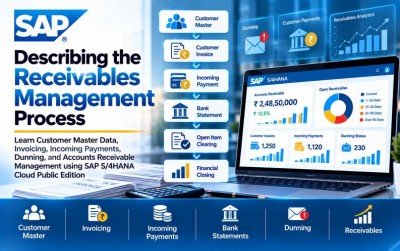
Describing the Receivables Management Process is a comprehensive SAP S/4HANA Cloud Public Edition training program designed for finance professionals, SAP Financial Accounting (FI) consultants, Accounts Receivable specialists, ERP implementation teams, business users, and SAP certification candidates who want to master Receivables Management processes.

This course provides practical knowledge of customer master data, Business Partner management, customer invoicing, credit memo processing, incoming payments, customer account clearing, bank statement processing, dunning procedures, receivables reporting, and Accounts Receivable period-end activities.

Learners will gain hands-on experience configuring customer master data, managing open receivables, processing customer invoices and payments, executing automatic payment processing, performing receivables closing activities, and generating financial reports to improve cash flow and customer account management.

The course prepares participants to confidently participate in SAP S/4HANA Cloud Public Edition implementation projects with a specialization in Accounts Receivable and Receivables Management.

Efficient Receivables Management is critical for maintaining healthy cash flow, improving customer relationships, reducing outstanding receivables, and ensuring accurate financial reporting. SAP S/4HANA Cloud Public Edition provides integrated Accounts Receivable capabilities that help organizations manage customer master data, invoice processing, incoming payments, collections, dunning, and period-end closing activities.

This course introduces the complete Receivables Management lifecycle, beginning with customer master data and Business Partner concepts, progressing through customer invoicing, payment processing, account maintenance, bank statement processing, receivable reporting, and financial closing.

Learners will understand how to configure enterprise receivables processes while integrating Accounts Receivable with Financial Accounting, Sales, Banking, and the Lead-to-Cash business process.

By the end of this course, participants will possess the practical skills required to configure, implement, and manage enterprise Receivables Management using SAP S/4HANA Cloud Public Edition.

Who Should Attend

  • SAP FI Consultants
  • SAP Accounts Receivable Consultants
  • SAP S/4HANA Cloud Consultants
  • Finance Professionals
  • Accounts Receivable Specialists
  • Financial Controllers
  • ERP Consultants
  • Business Analysts
  • Finance Managers
  • Customer Account Managers
  • Chartered Accountants
  • SAP Functional Consultants
  • ERP Implementation Teams
  • Banking Professionals
  • SAP Certification Candidates

Skills You Will Gain

  • SAP Accounts Receivable
  • SAP Receivables Management
  • SAP S/4HANA Cloud Public Edition
  • Business Partner Management
  • Customer Master Data
  • Customer-Vendor Integration
  • Customer Invoice Processing
  • Credit Memo Processing
  • Open Item Management
  • Incoming Payments
  • Bank Statement Processing
  • Customer Account Clearing
  • Dunning Management
  • Receivables Reporting
  • Financial Closing
  • Foreign Currency Valuation
  • Balance Confirmation
  • Accounts Receivable Regrouping
  • Receivable Value Adjustments
  • Lead-to-Cash Integration

Career Opportunities

  • SAP FI Consultant
  • SAP Accounts Receivable Consultant
  • SAP S/4HANA Cloud Consultant
  • Accounts Receivable Specialist
  • Finance Business Analyst
  • Financial Controller
  • ERP Functional Consultant
  • Customer Accounts Manager
  • Financial Systems Consultant
  • SAP Functional Analyst
  • Finance Manager
  • Banking Operations Specialist
  • ERP Implementation Consultant
  • Credit & Collections Analyst
  • Business Process Consultant

Certification Preparation

This course aligns with the SAP Learning Journey Describing the Receivables Management Process and prepares learners for SAP S/4HANA Cloud Public Edition certification topics related to Customer Master Data, Accounts Receivable, Incoming Payments, Dunning, Bank Statement Processing, and Receivables Closing Activities.

What will i learn?

  • Understand the Business Partner concept.
  • Configure Customer Master Data.
  • Manage Customer-Vendor Integration.
  • Maintain Accounts Receivable master data.
  • Process customer invoices and credit memos.
  • Manage open receivables.
  • Perform account maintenance.
  • Execute incoming payment processing.
  • Process manual and automatic customer payments.
  • Import and process electronic bank statements.
  • Clear customer open items.
  • Execute dunning procedures.
  • Generate receivables reports.
  • Perform Accounts Receivable period-end closing.
  • Support SAP Receivables Management implementation projects.

Requirements

  • Basic Financial Accounting
  • Accounts Receivable Fundamentals
  • ERP Concepts
  • Basic SAP Navigation
  • Computer or Laptop
  • Internet Connection
  • SAP S/4HANA Cloud Public Edition Access (Recommended)
  • SAP Fiori Launchpad

Frequently asked question

Yes. The course starts with Accounts Receivable fundamentals before progressing into customer master data, invoicing, incoming payments, dunning, reporting, and financial closing activities.

Yes. You will learn the Business Partner concept, Customer Master Data, Customer-Vendor Integration, and master data reporting required for Accounts Receivable processes.

Yes. The course explains customer invoice posting, credit memo processing, account maintenance, invoice reporting, customer correspondence, and integration with the Lead-to-Cash process.

Absolutely. Learners will process manual and automatic incoming payments, manage payment differences, import bank statements, clear customer open items, and execute post-processing activities.

Yes. The course covers electronic bank statement import, customer account clearing, payment post-processing, Direct Debit, SEPA payments, and payment reporting.

Yes. Learners will perform balance confirmation, foreign currency valuation, Accounts Receivable regrouping, receivable value adjustments, and financial closing activities.

Yes. The course introduces dunning procedures, customer correspondence, collections activities, and receivables monitoring to improve payment collection efficiency.

Yes. This course follows the SAP Learning Journey and prepares learners for Accounts Receivable and Receivables Management topics within SAP S/4HANA Cloud Public Edition certification.

  • Lesson 01 00:00:00
    Module 1 Overview

    Customer master data forms the foundation of every Accounts Receivable process. SAP S/4HANA Cloud Public Edition uses the Business Partner concept to centrally manage customer information, support Customer-Vendor Integration, and maintain accurate master data for financial transactions.

    This module introduces the Business Partner framework, Customer Master Data, Customer-Vendor Integration (CVI), and master data reporting. Learners will understand how properly maintained customer master records improve financial accuracy, streamline receivables processes, and support enterprise reporting.

    By the end of this module, learners will be able to manage customer master data required for efficient Accounts Receivable operations in SAP S/4HANA Cloud Public Edition.

    What You Will Learn

    • Understand the Business Partner concept.
    • Configure Customer Master Data.
    • Maintain customer records.
    • Explain Customer-Vendor Integration (CVI).
    • Manage customer master data fields.
    • Perform customer master maintenance.
    • Generate master data reports.
    • Improve master data quality.
    • Support Accounts Receivable processes.

    Units in This Module

    • Unit 1.1: Managing Customer Master Data
    • Unit 1.2: Identifying Key Customer Master Data Fields for Accounts Receivable
    • Unit 1.3: Discovering Customer Master Data Maintenance Methods
  • Lesson 02 00:00:00
    1.1 Managing Customer Master Data

    This unit introduces Customer Master Data management and explains how Business Partner records are created, maintained, and used throughout Accounts Receivable processes.

    Key Topics

    • Business Partner
    • Customer Master Data
    • Customer Records
    • Master Data Maintenance
    • Customer Roles
    • Financial Data
    • Organizational Data
    • SAP S/4HANA Cloud
  • Lesson 03 00:00:00
    1.2 Identifying Key Customer Master Data Fields for Accounts Receivable

    Learners will identify the essential master data fields required for Accounts Receivable, including company code data, payment terms, reconciliation accounts, correspondence settings, and financial control information.

    Key Topics

    • Company Code Data
    • Payment Terms
    • Reconciliation Accounts
    • Customer Classification
    • Credit Information
    • Correspondence Data
    • Financial Settings
    • Accounts Receivable
  • Lesson 04 00:00:00
    1.3 Discovering Customer Master Data Maintenance Methods

    This unit focuses on customer master maintenance methods, Business Partner management, Customer-Vendor Integration, and reporting tools used to maintain accurate customer information.

    Key Topics

    • Customer-Vendor Integration
    • Business Partner Maintenance
    • Master Data Reporting
    • Customer Updates
    • Data Validation
    • Master Data Governance
    • SAP Reporting
    • Financial Master Data

  • Lesson 01 00:00:00
    Module 2 Overview

    Accounts Receivable involves much more than customer invoicing. Organizations must efficiently manage customer invoices, credit memos, account maintenance, collections, customer correspondence, dunning procedures, and integration with the Lead-to-Cash process.

    This module introduces the complete Receivables Management lifecycle, enabling learners to manage customer transactions while maintaining accurate customer accounts and improving collection efficiency.

    By the end of this module, learners will be able to manage end-to-end Accounts Receivable operations using SAP S/4HANA Cloud Public Edition.

    What You Will Learn

    • Process customer invoices.
    • Process credit memos.
    • Perform account maintenance.
    • Generate invoice management reports.
    • Manage customer correspondence.
    • Execute dunning procedures.
    • Monitor outstanding receivables.
    • Integrate Accounts Receivable with Lead-to-Cash.
    • Improve collection efficiency.

    Units in This Module

    • Unit 2.1: Illustrating Open Receivables Management
  • Lesson 02 00:00:00
    2.1 Illustrating Open Receivables Management

    This unit explains the complete Receivables Management process, including customer invoice processing, credit memo management, account maintenance, receivables monitoring, customer correspondence, dunning, and integration with enterprise sales processes.

    Key Topics

    • Customer Invoices
    • Credit Memos
    • Open Receivables
    • Customer Accounts
    • Invoice Management
    • Customer Correspondence
    • Dunning Process
    • Lead-to-Cash Integration

  • Lesson 01 00:00:00
    Module 3 Overview

    Managing customer payments efficiently is essential for maintaining healthy cash flow, reducing outstanding receivables, and ensuring accurate financial records. SAP S/4HANA Cloud Public Edition provides comprehensive tools to process manual and automatic incoming payments, import electronic bank statements, clear customer open items, manage payment differences, and generate payment reports.

    This module introduces the complete customer payment lifecycle, including incoming payment processing, payment correspondence, bank statement processing, automatic clearing, Direct Debit, SEPA payments, post-processing activities, and payment reporting.

    By the end of this module, learners will be able to confidently manage customer payment processes using SAP S/4HANA Cloud Public Edition.

    What You Will Learn

    • Post manual incoming payments.
    • Process automatic customer payments.
    • Manage payment differences.
    • Process payment correspondence.
    • Import electronic bank statements.
    • Clear customer open items.
    • Execute bank statement post-processing.
    • Process Direct Debit and SEPA payments.
    • Generate payment reports.

    Units in This Module

    • Unit 3.1: Customer Payments in Receivables Management
  • Lesson 02 00:00:00
    3.1 Customer Payments in Receivables Management

    This unit explains how customer payments are processed throughout the Accounts Receivable lifecycle. Learners will understand manual payment posting, automatic payment processing, electronic bank statement import, customer account clearing, payment correspondence, and payment reporting.

    Key Topics

    • Incoming Payments
    • Manual Payment Processing
    • Automatic Payment Processing
    • Payment Differences
    • Bank Statement Processing
    • Customer Account Clearing
    • Direct Debit
    • SEPA Payments
    • Payment Correspondence
    • Payment Reporting

  • Lesson 01 00:00:00
    Module 4 Overview

    Period-end closing activities ensure that Accounts Receivable records are complete, accurate, and compliant with financial reporting requirements. SAP S/4HANA Cloud Public Edition provides tools for balance confirmation, foreign currency valuation, receivables regrouping, value adjustments, and financial closing.

    This module introduces the procedures required to prepare and complete Accounts Receivable period-end activities, helping organizations produce reliable financial statements while maintaining compliance with accounting standards.

    By the end of this module, learners will be able to execute Accounts Receivable closing activities and support enterprise financial closing processes.

    What You Will Learn

    • Execute balance confirmations.
    • Perform foreign currency valuation.
    • Execute Accounts Receivable regrouping.
    • Perform receivable value adjustments.
    • Prepare Accounts Receivable for financial closing.
    • Analyze receivable balances.
    • Support period-end reconciliation.
    • Improve financial reporting accuracy.
    • Complete Accounts Receivable closing activities.

    Units in This Module

    • Unit 4.1: Executing Accounts Receivable Period Activities
    • Unit 4.2: Using Accounts Receivable Closing Activities
  • Lesson 02 00:00:00
    4.1 Executing Accounts Receivable Period Activities

    This unit introduces the operational activities performed during the Accounts Receivable period-end process. Learners will execute balance confirmations, foreign currency valuation, receivable regrouping, and value adjustment procedures.

    Key Topics

    • Balance Confirmation
    • Foreign Currency Valuation
    • Receivable Regrouping
    • Value Adjustments
    • Financial Closing
    • Period-End Activities
    • Accounts Receivable
    • SAP Financial Closing
  • Lesson 03 00:00:00
    4.2 Using Accounts Receivable Closing Activities

    This unit focuses on the complete Accounts Receivable closing process, including reconciliation, reporting, financial adjustments, and preparation of receivable data for financial statements.

    Key Topics

    • Closing Activities
    • Financial Reconciliation
    • Accounts Receivable Reporting
    • Financial Statements
    • Receivable Analysis
    • Closing Reports
    • Financial Adjustments
    • Period-End Reporting

  • Lesson 01 00:00:00
    Practical Exercises

    Throughout this course, learners will complete hands-on implementation exercises using SAP S/4HANA Cloud Public Edition – Receivables Management.

    Participants will perform the following practical exercises:

    • Configure Business Partner records.
    • Maintain Customer Master Data.
    • Configure Customer-Vendor Integration (CVI).
    • Create customer master records.
    • Maintain payment terms and reconciliation accounts.
    • Post customer invoices.
    • Process credit memos.
    • Perform account maintenance.
    • Execute customer correspondence.
    • Run dunning procedures.
    • Monitor open receivables.
    • Post manual incoming payments.
    • Process automatic incoming payments.
    • Import electronic bank statements.
    • Clear customer open items.
    • Execute bank statement post-processing.
    • Process Direct Debit and SEPA payments.
    • Generate payment reports.
    • Execute balance confirmation.
    • Perform foreign currency valuation.
    • Execute Accounts Receivable regrouping.
    • Perform receivable value adjustments.
    • Complete Accounts Receivable period-end closing.
  • Lesson 02 00:00:00
    Enterprise Capstone Project

    In this capstone project, learners will implement a complete Accounts Receivable and Receivables Management solution for a fictional multinational organization using SAP S/4HANA Cloud Public Edition.

    The project simulates a real SAP implementation where learners configure customer master data, process customer invoices, manage incoming payments, execute dunning procedures, perform bank statement processing, and complete Accounts Receivable period-end closing activities.

    Phase 1 – Customer Master Data Configuration

    Configure:

    • Business Partner Master Data
    • Customer Master Records
    • Customer Roles
    • Customer-Vendor Integration (CVI)
    • Company Code Data
    • Payment Terms
    • Reconciliation Accounts
    • Master Data Reporting

    Phase 2 – Open Receivables Management

    Implement:

    • Customer Invoice Processing
    • Credit Memo Processing
    • Customer Account Maintenance
    • Customer Correspondence
    • Invoice Management Reporting
    • Open Item Monitoring
    • Dunning Procedures
    • Lead-to-Cash Integration

    Phase 3 – Customer Payment Processing

    Configure:

    • Manual Incoming Payments
    • Automatic Incoming Payments
    • Payment Difference Processing
    • Electronic Bank Statement Import
    • Customer Open Item Clearing
    • Direct Debit Processing
    • SEPA Payment Processing
    • Payment Reporting

    Phase 4 – Accounts Receivable Closing Activities

    Configure:

    • Balance Confirmation
    • Foreign Currency Valuation
    • Accounts Receivable Regrouping
    • Receivable Value Adjustments
    • Financial Reconciliation
    • Period-End Closing
    • Accounts Receivable Reporting
    • Financial Closing Preparation

    Expected Project Outcome

    Upon successful completion of the capstone project, learners will be able to:

    • Configure Business Partner master data.
    • Maintain Customer Master Data.
    • Configure Customer-Vendor Integration.
    • Process customer invoices and credit memos.
    • Manage customer accounts.
    • Execute dunning procedures.
    • Process manual and automatic customer payments.
    • Import electronic bank statements.
    • Clear customer open items.
    • Generate Accounts Receivable reports.
    • Execute balance confirmation.
    • Perform foreign currency valuation.
    • Complete Accounts Receivable period-end closing.
    • Improve receivables management efficiency.
    • Support enterprise SAP Receivables Management implementation projects.

Jittesh Purrohit

Lectures

13

Skill level

Intermediate

Expiry period

Lifetime

Related courses