Course description

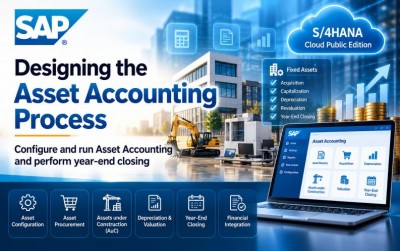
Designing the Asset Accounting Process is a comprehensive SAP S/4HANA Cloud Public Edition training program designed for finance professionals, SAP consultants, asset accountants, ERP implementation teams, and certification candidates who want to master Asset Accounting configuration and business processes.

This course provides practical knowledge of configuring Asset Accounting, managing fixed assets, integrating Asset Accounting with Materials Management and Financial Accounting, processing Assets under Construction (AuC), executing depreciation and valuation activities, and performing year-end closing procedures.

Learners will gain hands-on experience configuring asset classes, account determination, validation and substitution rules, procurement integration, down payments for assets under construction, asset valuation adjustments, depreciation processing, and Asset Accounting year-end closing using SAP S/4HANA Cloud Public Edition.

The course also prepares learners to participate in SAP implementation projects involving Fixed Asset Management and Financial Accounting.

Asset Accounting is one of the most critical components of enterprise financial management. Organizations use SAP Asset Accounting to manage the complete lifecycle of fixed assets—from acquisition and capitalization to depreciation, transfers, retirement, and year-end reporting.

This course introduces the configuration and business processes required to implement Asset Accounting in SAP S/4HANA Cloud Public Edition. Learners will configure asset classes, valuation settings, account determination, validations, and substitutions before progressing to procurement integration, assets under construction, depreciation processing, asset valuation, and year-end closing activities.

Special emphasis is placed on integrating Asset Accounting with Materials Management and Financial Accounting while ensuring compliance with accounting principles and enterprise reporting requirements.

By the end of this course, participants will have the practical knowledge required to configure, maintain, and manage enterprise Asset Accounting processes within SAP S/4HANA Cloud Public Edition.

Who Should Attend

  • SAP FI Consultants
  • SAP Asset Accounting Consultants
  • SAP S/4HANA Cloud Consultants
  • Finance Consultants
  • Financial Accountants
  • Asset Accountants
  • ERP Consultants
  • Chartered Accountants
  • Financial Controllers
  • Finance Managers
  • Business Analysts
  • SAP Functional Consultants
  • ERP Implementation Teams
  • Accounting Professionals
  • SAP Certification Candidates

Skills You Will Gain

  • SAP Asset Accounting
  • SAP S/4HANA Cloud Public Edition
  • Asset Classes
  • Account Determination
  • Asset Valuation
  • Asset Master Data
  • Validation Rules
  • Substitution Rules
  • Fixed Asset Procurement
  • Assets under Construction (AuC)
  • Down Payments
  • Depreciation Processing
  • Asset Revaluation
  • Post-Capitalization
  • Write-up Processing
  • Unplanned Depreciation
  • Year-End Closing
  • Asset History Sheet
  • Financial Accounting Integration
  • Materials Management Integration

Career Opportunities

  • SAP FI-AA Consultant
  • SAP Financial Accounting Consultant
  • SAP S/4HANA Cloud Consultant
  • Asset Accounting Consultant
  • Fixed Asset Accountant
  • Finance Business Analyst
  • ERP Functional Consultant
  • SAP Implementation Consultant
  • Financial Systems Consultant
  • SAP Finance Specialist
  • Financial Controller
  • Finance Manager
  • ERP Project Consultant
  • Accounting Systems Analyst
  • SAP Functional Analyst

Certification Preparation

This course aligns with the SAP Learning Journey for Designing the Asset Accounting Process and prepares learners for Asset Accounting topics commonly assessed in SAP S/4HANA Cloud Public Edition certification, including asset configuration, procurement integration, valuation, depreciation, and year-end closing activities.

Next, I'll generate in the same enterprise format:

  • 8 Professional FAQs
  • Detailed Module 1–3
  • Detailed Unit Descriptions
  • Hands-on Practical Exercises
  • Enterprise Capstone Project
  • Course Completion Summary
  • SEO & Marketing Assets
What will i learn?

  • Configure Asset Accounting.
  • Configure asset classes.
  • Configure account determination.
  • Configure valuation settings.
  • Manage asset master data.
  • Configure validations and substitutions.
  • Procure fixed assets.
  • Manage Assets under Construction (AuC).
  • Process down payments.
  • Execute asset valuation.
  • Perform depreciation adjustments.
  • Execute post-capitalization.
  • Perform write-ups and unplanned depreciation.
  • Complete Asset Accounting year-end closing.
  • Support SAP Asset Accounting implementation projects.

Requirements

  • Basic Accounting Concepts
  • Financial Accounting Fundamentals
  • ERP Basics
  • Understanding of Fixed Assets
  • Computer or Laptop
  • Internet Connection
  • SAP S/4HANA Cloud Public Edition Access (Recommended)
  • SAP Fiori Launchpad

Frequently asked question

Yes. This course starts with the fundamentals of Asset Accounting before progressing to asset configuration, procurement integration, asset valuation, depreciation, Assets under Construction (AuC), and year-end closing. It is suitable for finance professionals, SAP consultants, accountants, and beginners entering SAP Financial Accounting.

Yes. The course covers Asset Accounting configuration including asset classes, account determination, valuation settings, validation rules, substitution rules, and asset master data management required for SAP S/4HANA Cloud Public Edition implementations.

Absolutely. Learners will understand how fixed assets are procured through Materials Management, including valuated and non-valuated goods receipts, procurement integration, and asset acquisition processes.

Yes. A dedicated module explains Assets under Construction (AuC), including down payments, settlement processes, clearing activities, and accounting procedures for capital projects.

Yes. The course covers depreciation processing, write-ups, post-capitalization, unplanned depreciation, asset revaluation, and valuation adjustments according to SAP best practices.

Yes. Learners will perform Asset Accounting year-end closing, depreciation execution, Asset History Sheet generation, valuation adjustments, and financial reporting activities.

Yes. The course follows the SAP Learning Journey Designing the Asset Accounting Process and prepares learners for Asset Accounting implementation topics included within SAP S/4HANA Cloud Public Edition learning paths.

You will learn Asset Accounting configuration, fixed asset procurement, Assets under Construction, depreciation processing, valuation adjustments, financial integration, and enterprise Asset Accounting implementation.

  • Lesson 01 00:00:00
    Module 1 Overview

    Asset Accounting configuration provides the foundation for managing fixed assets throughout their lifecycle. Proper configuration ensures accurate capitalization, depreciation, valuation, and financial reporting while complying with organizational accounting policies.

    This module introduces the configuration settings required for SAP S/4HANA Cloud Public Edition Asset Accounting, including asset classes, account determination, valuation settings, low-value asset controls, validation rules, and substitution techniques.

    By the end of this module, learners will understand how to configure the core components required to implement Asset Accounting in an enterprise environment.

    What You Will Learn

    • Understand Asset Accounting configuration.
    • Configure asset classes.
    • Configure account determination.
    • Configure valuation settings.
    • Configure low-value asset controls.
    • Manage asset master data.
    • Configure validation rules.
    • Configure substitution rules.
    • Apply SAP Asset Accounting best practices.

    Units in This Module

    • Unit 1.1: Configuring Fixed Asset Class
    • Unit 1.2: Validating and Substituting Asset Master Data
  • Lesson 02 00:00:00
    1.1 Configuring Fixed Asset Class

    Asset Classes determine how fixed assets are categorized, valued, depreciated, and reported within SAP Asset Accounting. This unit explains asset class configuration, account determination, valuation settings, and controls for low-value assets.

    Key Topics

    • Asset Classes
    • Fixed Assets
    • Account Determination
    • Valuation Settings
    • Depreciation Areas
    • Low-Value Assets
    • Asset Configuration
    • Financial Accounting Integration
  • Lesson 03 00:00:00
    1.2 Validating and Substituting Asset Master Data

    Validation and substitution improve the quality and consistency of Asset Master Data by enforcing business rules and automating data entry during asset creation and maintenance.

    Learners will configure validation logic, substitution rules, asset master controls, and enterprise data governance.

    Key Topics

    • Asset Master Data
    • Validation Rules
    • Substitution Rules
    • Business Rules
    • Data Governance
    • Asset Maintenance
    • SAP Configuration
    • Financial Controls

  • Lesson 01 00:00:00
    Module 2 Overview

    Asset Accounting integrates closely with Materials Management and Financial Accounting to ensure accurate recording of fixed asset acquisitions, capitalization, payments, and accounting transactions.

    This module explains how Asset Accounting interacts with procurement processes, including fixed asset procurement, valuated and non-valuated goods receipts, Assets under Construction (AuC), down payments, and settlement procedures.

    By the end of this module, learners will understand how enterprise procurement activities integrate seamlessly with Asset Accounting in SAP S/4HANA Cloud Public Edition.

    What You Will Learn

    • Understand Asset Accounting integration.
    • Procure fixed assets.
    • Configure asset procurement.
    • Process valuated goods receipts.
    • Process non-valuated goods receipts.
    • Manage Assets under Construction (AuC).
    • Process down payments.
    • Execute settlement activities.
    • Integrate procurement with Financial Accounting.

    Units in This Module

    • Unit 2.1: Procuring Assets Using Materials Management
    • Unit 2.2: Maintaining Down Payments for Assets Under Construction (AuC)
  • Lesson 02 00:00:00
    2.1 Procuring Assets Using Materials Management

    This unit explains how fixed assets are procured through SAP Materials Management. Learners will understand procurement workflows, purchase orders, valuated goods receipts, non-valuated goods receipts, and financial postings associated with fixed asset acquisition.

    Key Topics

    • Asset Procurement
    • Materials Management
    • Purchase Orders
    • Goods Receipt
    • Asset Acquisition
    • Financial Posting
    • Procurement Integration
    • SAP MM Integration
  • Lesson 03 00:00:00
    2.2 Maintaining Down Payments for Assets Under Construction (AuC)

    Assets under Construction (AuC) are used to track capital investments before they become operational assets. Learners will manage down payments, clearing activities, settlement processes, and accounting transactions related to capital projects.

    Key Topics

    • Assets under Construction
    • AuC
    • Down Payments
    • Down Payment Clearing
    • Settlement
    • Capital Projects
    • Asset Capitalization
    • Financial Accounting

  • Lesson 01 00:00:00
    Module 3 Overview

    Year-end closing is one of the most important processes in Asset Accounting, ensuring that asset values, depreciation, and financial records are accurate before the financial year is closed. SAP S/4HANA Cloud Public Edition provides standardized procedures for depreciation processing, asset valuation, financial reporting, and year-end closing activities.

    This module introduces the complete year-end closing process, including asset postings for individual accounting principles, depreciation execution, asset revaluation, Asset History Sheet reporting, forecast analysis, write-ups, unplanned depreciation, and post-capitalization.

    By the end of this module, learners will be able to perform Asset Accounting year-end closing activities while ensuring financial accuracy and compliance with accounting standards.

    What You Will Learn

    • Understand Asset Accounting year-end closing.
    • Execute depreciation runs.
    • Perform asset postings.
    • Manage accounting principles.
    • Execute asset revaluation.
    • Analyze depreciation results.
    • Generate Asset History Sheets.
    • Perform forecast analysis.
    • Execute write-ups.
    • Perform unplanned depreciation.
    • Execute post-capitalization.
    • Complete Asset Accounting year-end closing.

    Units in This Module

    • Unit 3.1: Executing and Changing the Valuation of Fixed Assets
    • Unit 3.2: Executing a Year-End Closing of Asset Accounting
  • Lesson 02 00:00:00
    3.1 Executing and Changing the Valuation of Fixed Assets

    Asset valuation ensures that fixed assets accurately reflect their financial value throughout their lifecycle. This unit explains valuation changes, depreciation adjustments, write-ups, post-capitalization, and unplanned depreciation for individual accounting principles.

    Learners will understand how valuation activities support accurate financial reporting and compliance with accounting standards.

    Key Topics

    • Fixed Asset Valuation
    • Asset Revaluation
    • Depreciation Processing
    • Write-Up
    • Post-Capitalization
    • Unplanned Depreciation
    • Accounting Principles
    • Financial Reporting
  • Lesson 03 00:00:00
    3.2 Executing a Year-End Closing of Asset Accounting

    Year-end closing finalizes Asset Accounting transactions for the fiscal year by executing depreciation runs, validating asset balances, generating reports, analyzing forecasts, and completing financial closing procedures.

    Learners will perform Asset History Sheet reporting, analyze depreciation logs, resolve processing issues, and prepare Asset Accounting for the next fiscal period.

    Key Topics

    • Year-End Closing
    • Depreciation Run
    • Asset History Sheet
    • Forecast Analysis
    • Closing Activities
    • Financial Reporting
    • Error Log Analysis
    • SAP Asset Accounting

  • Lesson 01 00:00:00
    Practical Exercises

    Throughout this course, learners will complete hands-on implementation exercises using SAP S/4HANA Cloud Public Edition – Asset Accounting.

    Participants will perform the following practical exercises:

    • Configure Asset Accounting settings.
    • Create Asset Classes.
    • Configure Account Determination.
    • Configure Valuation Settings.
    • Configure Low-Value Asset controls.
    • Create Asset Master Records.
    • Configure Validation Rules.
    • Configure Substitution Rules.
    • Procure Fixed Assets using Materials Management.
    • Process Valuated Goods Receipts.
    • Process Non-Valuated Goods Receipts.
    • Create Assets under Construction (AuC).
    • Process Down Payments for AuC.
    • Clear Down Payments.
    • Execute Asset Capitalization.
    • Run Depreciation.
    • Execute Asset Revaluation.
    • Process Write-Ups.
    • Perform Unplanned Depreciation.
    • Execute Post-Capitalization.
    • Generate Asset History Sheets.
    • Complete Year-End Closing Activities.
  • Lesson 02 00:00:00
    Enterprise Capstone Project

    Implementing Enterprise Asset Accounting in SAP S/4HANA Cloud Public Edition

    In this capstone project, learners will implement a complete Asset Accounting solution for a fictional enterprise using SAP S/4HANA Cloud Public Edition.

    The project simulates a real-world SAP implementation where participants configure asset master data, integrate procurement with Asset Accounting, manage capital projects, perform depreciation, and execute year-end financial closing.

    Phase 1 – Asset Accounting Configuration

    Configure:

    • Asset Accounting Settings
    • Asset Classes
    • Account Determination
    • Valuation Settings
    • Depreciation Areas
    • Low-Value Asset Configuration
    • Validation Rules
    • Substitution Rules

    Phase 2 – Asset Master Data

    Configure:

    • Asset Master Records
    • Asset Groups
    • Asset Attributes
    • Asset Classification
    • Useful Life
    • Depreciation Keys
    • Organizational Assignments
    • Financial Controls

    Phase 3 – Asset Procurement

    Implement:

    • Asset Purchase Orders
    • Goods Receipts
    • Asset Acquisition
    • Materials Management Integration
    • Financial Postings
    • Asset Capitalization
    • Procurement Validation
    • Asset Monitoring

    Phase 4 – Assets under Construction (AuC)

    Configure:

    • Assets under Construction
    • Down Payments
    • Down Payment Clearing
    • Capital Project Tracking
    • Settlement Rules
    • Asset Transfers
    • AuC Monitoring
    • Financial Integration

    Phase 5 – Asset Valuation and Closing

    Execute:

    • Depreciation Runs
    • Asset Revaluation
    • Write-Up Processing
    • Unplanned Depreciation
    • Post-Capitalization
    • Asset History Sheet
    • Forecast Analysis
    • Year-End Closing

    Expected Project Outcome

    Upon successful completion of the capstone project, learners will be able to:

    • Implement SAP Asset Accounting.
    • Configure Asset Classes and Account Determination.
    • Manage Asset Master Data.
    • Procure Fixed Assets.
    • Configure Assets under Construction.
    • Process Down Payments.
    • Execute Asset Capitalization.
    • Run Depreciation.
    • Perform Asset Revaluation.
    • Execute Year-End Closing.
    • Generate Asset Reports.
    • Support enterprise SAP Asset Accounting implementation projects.

Jittesh Purrohit

Lectures

11

Skill level

Intermediate

Expiry period

Lifetime

Related courses