Course description

Outlining the Financial Accounting Overview is a beginner-friendly SAP S/4HANA Cloud Public Edition training program designed for students, fresh graduates, finance professionals, business users, SAP consultants, and anyone starting their SAP Financial Accounting journey.

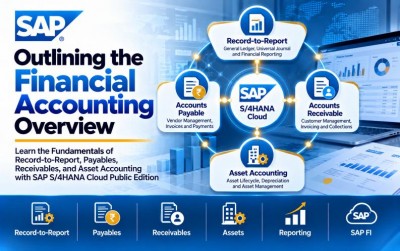
This course introduces the core concepts of SAP Financial Accounting (FI) and explains how financial business processes are integrated within SAP S/4HANA Cloud Public Edition. Learners will explore the Record-to-Report process, Payables Management, Receivables Management, Asset Accounting, the Universal Journal, enterprise organizational structures, and financial reporting fundamentals.

The course provides a comprehensive overview of SAP Financial Accounting modules, enabling learners to understand how financial transactions are recorded, managed, and reported across an organization. It forms the foundation for advanced SAP Financial Accounting and SAP S/4HANA implementation courses.

SAP Financial Accounting is the backbone of enterprise financial management. Organizations rely on SAP S/4HANA Cloud Public Edition to record business transactions, manage financial data, monitor assets and liabilities, and generate statutory and management reports.

This course provides an overview of the essential financial processes used within SAP Financial Accounting, including Record-to-Report (R2R), Accounts Payable, Accounts Receivable, and Asset Accounting. Learners will understand how the Universal Journal records financial transactions, how business partners are managed, and how different accounting modules integrate to support accurate financial reporting.

By completing this course, participants will gain a solid understanding of SAP Financial Accounting concepts and be prepared to continue with advanced SAP Finance learning journeys.

Who Should Attend

  • SAP Beginners
  • Fresh Graduates
  • Finance Students
  • Commerce Students
  • ERP Beginners
  • SAP FI Consultants (Beginners)
  • Business Analysts
  • Financial Accountants
  • Finance Professionals
  • Accounts Executives
  • SAP Functional Consultants
  • ERP Implementation Team Members
  • Internal Auditors
  • Business Process Analysts
  • SAP Certification Aspirants

Skills You Will Gain

  • SAP Financial Accounting
  • SAP S/4HANA Cloud Public Edition
  • Record-to-Report (R2R)
  • Universal Journal
  • General Ledger Fundamentals
  • Organizational Structure
  • Business Partner Concept
  • Accounts Payable
  • Accounts Receivable
  • Asset Accounting
  • Financial Reporting
  • Enterprise Finance Processes
  • Financial Transaction Flow
  • SAP Financial Integration
  • ERP Financial Concepts

Career Opportunities

  • SAP FI Trainee
  • Junior SAP Consultant
  • Finance Executive
  • ERP Support Executive
  • Accounts Executive
  • SAP Functional Analyst
  • Financial Analyst
  • ERP Business Analyst
  • SAP Implementation Associate
  • Accounting Associate
  • Business Process Executive
  • SAP End User
  • Finance Operations Associate
  • SAP Support Consultant
  • Graduate ERP Consultant

Certification Preparation

What will i learn?

  • Understand SAP Financial Accounting fundamentals.
  • Explain the Record-to-Report (R2R) process.
  • Understand the Universal Journal concept.
  • Identify enterprise organizational structures.
  • Explain General Ledger Accounting fundamentals.
  • Understand Accounts Payable processes.
  • Understand Accounts Receivable processes.
  • Explain Asset Accounting concepts.
  • Understand Business Partner master data.
  • Recognize financial transaction flows.
  • Explain integration between SAP Finance modules.
  • Understand financial reporting fundamentals.
  • Build a strong foundation for advanced SAP Finance courses.

Requirements

  • Basic Accounting Concepts
  • Basic Computer Skills
  • Interest in ERP Systems
  • Computer or Laptop
  • Internet Connection
  • SAP S/4HANA Cloud Public Edition Access (Optional)
  • SAP Fiori Launchpad (Recommended)

Frequently asked question

Yes. This course is designed specifically for newcomers to SAP Finance and introduces all core Financial Accounting concepts from the ground up.

The course introduces:

Yes. You will understand how the Universal Journal records financial transactions and supports various financial reporting requirements.

Yes. The course introduces the organizational structures, business processes, business partner concepts, and reporting functions for both Accounts Payable and Accounts Receivable.

Yes. You will learn the basics of Asset Accounting, including asset lifecycle concepts, organizational structures, and key business processes.

No. This is an overview course designed to provide a conceptual understanding of SAP Financial Accounting before progressing to implementation-focused training.

Anyone starting a career in SAP Finance, ERP systems, or Financial Accounting will benefit from this course.

After this course, you can continue with:

  • Lesson 01 00:00:00
    Module 1 Overview

    The Record-to-Report (R2R) process is the foundation of Financial Accounting in SAP S/4HANA Cloud Public Edition. It captures financial transactions from across the enterprise, records them in the Universal Journal, and provides accurate financial information for operational, managerial, and statutory reporting.

    This module introduces the stages of the Record-to-Report process, explains how financial transactions are recorded in the Universal Journal, and explores the enterprise organizational structure that supports financial accounting. Learners will gain a clear understanding of how SAP integrates accounting information to provide a single source of truth for financial reporting.

    What You Will Learn

    • Understand the Record-to-Report (R2R) process.
    • Explain how financial transactions are recorded.
    • Understand the Universal Journal concept.
    • Explain enterprise organizational structures.
    • Identify value-related business transactions.
    • Understand General Ledger integration.
    • Explain reporting requirements.
    • Build a foundation for SAP Financial Accounting.

    Units in This Module

    • Unit 1.1: Describing the Steps in the Record-to-Report Process and How Financial Transactions Are Recorded in the Universal Journal
    • Unit 1.2: Outlining How the Universal Journal Is Supporting Various Reporting Requirements
    • Unit 1.3: Identifying Parts That Record All Value-Related Business Transactions and How the Enterprise Structure Is Used
  • Lesson 02 00:00:00
    1.1 Describing the Steps in the Record-to-Report Process and How Financial Transactions Are Recorded in the Universal Journal

    This unit introduces the complete Record-to-Report lifecycle and explains how financial transactions flow through SAP S/4HANA Cloud. Learners will understand the role of the Universal Journal in recording financial information and supporting enterprise reporting.

    Key Topics

    • Record-to-Report Process
    • Financial Transactions
    • Universal Journal
    • Journal Entries
    • General Ledger
    • Financial Accounting
    • SAP S/4HANA Cloud
    • Financial Reporting
  • Lesson 03 00:00:00
    1.2 Outlining How the Universal Journal Is Supporting Various Reporting Requirements

    This unit explains how the Universal Journal simplifies financial reporting by combining accounting information into a single data model. Learners will understand how SAP supports internal management reporting and external statutory reporting using the Universal Journal.

    Key Topics

    • Universal Journal
    • Financial Reporting
    • Management Reporting
    • Statutory Reporting
    • Reporting Structure
    • Financial Data
    • SAP Finance
    • Reporting Integration
  • Lesson 04 00:00:00
    1.3 Identifying Parts That Record All Value-Related Business Transactions and How the Enterprise Structure Is Used

    Learners will explore the enterprise organizational structure used in SAP Financial Accounting and understand how business transactions are captured across organizational units.

    Key Topics

    • Enterprise Structure
    • Company Code
    • Organizational Units
    • Business Transactions
    • Financial Integration
    • Value-Related Transactions
    • SAP Enterprise Structure
    • Financial Data Flow

  • Lesson 01 00:00:00
    Module 2 Overview

    Accounts Payable is responsible for managing supplier transactions, vendor master data, invoices, and payments. SAP S/4HANA Cloud Public Edition integrates Payables Management with Financial Accounting to ensure accurate recording of vendor liabilities and efficient payment processing.

    This module introduces the basic concepts of Payables Management, including vendor master data, Business Partner management, organizational structures, end-to-end payable processes, and financial reporting.

    By the end of this module, learners will understand how vendor transactions are processed and represented within SAP Financial Accounting.

    What You Will Learn

    • Understand Accounts Payable fundamentals.
    • Explain vendor master data.
    • Understand the Business Partner concept.
    • Identify Payables organizational structures.
    • Understand end-to-end payable processes.
    • Explain vendor financial transactions.
    • Understand subledger concepts.
    • Recognize Payables reporting.

    Units in This Module

    • Unit 2.1: Defining Payables Management and Its Organisational Structure
  • Lesson 02 00:00:00
    2.1 Defining Payables Management and Its Organisational Structure

    This unit introduces the organizational structure of Payables Management, explaining vendor master data, Business Partner concepts, subledgers, and how vendor transactions integrate with Financial Accounting.

    Key Topics

    • Accounts Payable
    • Vendor Master Data
    • Business Partner
    • Vendor Transactions
    • Subledger
    • Organizational Structure
    • Financial Accounting
    • Vendor Reporting

  • Lesson 01 00:00:00
    Module 3 Overview

    Receivables Management plays a vital role in maintaining an organization's cash flow by managing customer accounts, invoices, payments, and collections. SAP S/4HANA Cloud Public Edition integrates Accounts Receivable with Financial Accounting to ensure customer transactions are accurately recorded and reported.

    This module introduces the fundamentals of Receivables Management, including customer master data, Business Partner concepts, Accounts Receivable documents, organizational structures, and integration with General Ledger Accounting. Learners will also gain an understanding of receivables reporting and how customer transactions contribute to enterprise financial management.

    What You Will Learn

    • Understand Accounts Receivable fundamentals.
    • Explain customer master data.
    • Understand the Business Partner concept for customers.
    • Identify Receivables Management organizational structures.
    • Understand Accounts Receivable data flows.
    • Explain customer financial transactions.
    • Understand integration with General Ledger Accounting.
    • Recognize Receivables Management reporting capabilities.

    Units in This Module

    • Unit 3.1: Defining Receivables Management and Its Organizational Structure
  • Lesson 02 00:00:00
    3.1 Defining Receivables Management and Its Organizational Structure

    This unit introduces the organizational structure of Receivables Management and explains how customer accounts are represented in SAP S/4HANA Cloud Public Edition. Learners will understand customer master data, Business Partner concepts, Accounts Receivable documents, financial transaction processing, and integration with General Ledger Accounting.

    Key Topics

    • Accounts Receivable
    • Customer Master Data
    • Business Partner
    • Customer Transactions
    • Accounts Receivable Documents
    • Organizational Structure
    • General Ledger Integration
    • Receivables Reporting

  • Lesson 01 00:00:00
    Module 4 Overview

    Asset Accounting enables organizations to manage the complete lifecycle of fixed assets—from acquisition and capitalization to depreciation, transfer, retirement, and disposal. SAP S/4HANA Cloud Public Edition integrates Asset Accounting with General Ledger Accounting to ensure accurate asset valuation and financial reporting.

    This module introduces the basic concepts of Asset Accounting, including the asset lifecycle, asset organizational structure, and the relationship between Asset Accounting and General Ledger Accounting. Learners will gain a foundational understanding of how fixed assets are managed within SAP Financial Accounting.

    What You Will Learn

    • Understand Asset Accounting fundamentals.
    • Explain the asset lifecycle.
    • Identify asset organizational structures.
    • Understand asset master records.
    • Explain asset transactions.
    • Understand depreciation concepts.
    • Recognize integration with General Ledger Accounting.
    • Build a foundation for advanced Asset Accounting.

    Units in This Module

    • Unit 4.1: Understanding Assets, Their Life Cycle, and Organizational Structure
  • Lesson 02 00:00:00
    4.1 Understanding Assets, Their Life Cycle, and Organizational Structure

    This unit introduces the key concepts of Asset Accounting and explains how assets are created, managed, depreciated, and retired throughout their lifecycle. Learners will understand asset organizational structures and the integration between Asset Accounting and General Ledger Accounting.

    Key Topics

    • Asset Accounting
    • Asset Lifecycle
    • Asset Master Data
    • Asset Acquisition
    • Depreciation
    • Asset Retirement
    • Organizational Structure
    • General Ledger Integration

  • Lesson 01 00:00:00
    Practical Exercises

    Throughout this course, learners will complete introductory hands-on exercises using SAP S/4HANA Cloud Public Edition – Financial Accounting.

    Participants will perform the following practical exercises:

    • Explore the SAP Fiori Launchpad.
    • Navigate the Record-to-Report process.
    • Review Universal Journal entries.
    • Understand enterprise organizational structures.
    • Identify Company Codes and organizational units.
    • Explore General Ledger concepts.
    • Review vendor master data.
    • Explore Business Partner master records.
    • Understand customer master data.
    • Review Accounts Payable and Receivables documents.
    • Explore Asset Accounting master records.
    • Analyze financial transaction flows.
    • Understand financial reporting dashboards.
    • Explore integration between Financial Accounting modules.
  • Lesson 02 00:00:00
    Enterprise Learning Project

    Understanding SAP Financial Accounting Business Processes

    In this enterprise learning project, learners will explore how the core Financial Accounting processes work together within SAP S/4HANA Cloud Public Edition.

    Rather than configuring a complete SAP system, participants will analyze the end-to-end financial process, understand module integration, and trace how financial transactions flow across Record-to-Report, Accounts Payable, Accounts Receivable, and Asset Accounting.

    This project provides a practical understanding of enterprise finance operations and prepares learners for implementation-focused SAP Finance courses.

    Phase 1 – Understanding the Record-to-Report Process

    Explore:

    • Record-to-Report (R2R) lifecycle
    • Universal Journal
    • Financial transaction flow
    • General Ledger Accounting
    • Enterprise organizational structure
    • Financial reporting concepts

    Phase 2 – Exploring Accounts Payable

    Understand:

    • Vendor master data
    • Business Partner concept
    • Vendor lifecycle
    • Accounts Payable organizational structure
    • Vendor transactions
    • Financial reporting for payables
    • Integration with General Ledger

    Phase 3 – Exploring Accounts Receivable

    Learn:

    • Customer master data
    • Customer Business Partner
    • Customer transaction flow
    • Receivables Management
    • Accounts Receivable documents
    • Customer reporting
    • Integration with General Ledger

    Phase 4 – Understanding Asset Accounting

    Explore:

    • Asset lifecycle
    • Asset master records
    • Asset organizational structure
    • Asset acquisitions
    • Asset depreciation
    • Asset retirement
    • Asset Accounting integration with Financial Accounting

    Expected Learning Outcome

    Upon successful completion of this project, learners will be able to:

    • Explain the Record-to-Report process.
    • Understand the Universal Journal.
    • Identify Financial Accounting organizational structures.
    • Explain General Ledger fundamentals.
    • Understand Accounts Payable business processes.
    • Understand Accounts Receivable business processes.
    • Explain Asset Accounting fundamentals.
    • Understand Business Partner concepts.
    • Explain enterprise financial transaction flows.
    • Recognize integration between SAP Financial Accounting modules.
    • Interpret basic financial reporting concepts.
    • Build a strong conceptual foundation for SAP Financial Accounting.

Jittesh Purrohit

Lectures

12

Skill level

Intermediate

Expiry period

Lifetime

Related courses